SEO & AI Visibility
UWM.edu Top Level Audit
A focused walkthrough of where you're starting, what is working well, and what are the largest opportunities for uwm.edu.


Today’s Agenda
What we will cover in this walkthrough presentation:
Document Orientation
How the audit is structured and how to read each checkpoint.Baseline Performance
Historical traffic, organic search, AI visibility, and competitive position.Audit Findings
What is Good / Functional, and the highest-impact opportunities.Q&A / Discussion
Time to clarify findings before the roadmap phase.Top Priorities
The 3 levers that matter most and why they sequence in this order.Next Steps
Two follow-on audits Friday, then the roadmap in early June.
How to read the audit document
33 audit checkpoints
- On-Page Content & Structure
- Metadata and Page Signals
- Navigation, Internal Linking, and Content Relationships
- Technical SEO Foundations
- Off-Site Presence & Authority
Each checkpoint includes
- What we checked and why it matters
- Status, Impact, and Complexity rating
- Findings and general recommendations
Reference layer
A glossary is included at the end of the audit so technical language can be translated consistently.
Baseline performance is moving in the right direction
Overall traffic is growing across channels.
As paid investment increases and AI continues to change how students search, this is a good moment to ensure organic and AI visibility are keeping pace.Data window
Source: Google Analytics (309445110, “all” / institutional view) and Google Search Console.
Current: 2025-04-16 → 2026-04-15
Prior: 2024-04-16 → 2025-04-15
Notable channel moves: Paid Social +347%, Paid Other +136%, SMS -99%.
The big picture: a strong foundation, clear opportunities
12 checkpoints
Strong areas that give the roadmap a real foundation.
3 checkpoints
Functional now, with refinements worth making alongside broader work. No issues flagged in this run.
18 checkpoints
The findings we will spend most of today’s time on.
This isn't a broken site. The foundation is there.
15 of 33 checkpoints came back as Good or OK as-is. The 18 items that need attention sit on top of a foundation that is already working.
What’s already working: site and crawl foundation
Content Duplication
No near-duplicate content across 238 pages. At UWM’s scale, that is not a given.Outbound Links
Links point to UW System resources, accreditation bodies, and government / regulatory sources. No broken outbound destinations were flagged.XML Sitemap
Present, valid, and discoverable. Crawlers can find UWM content.Human-Readable URLs
Clean across all 238 indexable pages; users can read a URL and understand what the page is about.URL Parameters
No parameterized URLs flagged as indexation risks. No immediate action: add canonical tags or GSC parameter handling if filter/sort parameters appear in the index later.Search / subdomain hygiene
On-site search results are blocked from indexing; subdomains, wildcard subdomains, and alternate language versions were clean or not applicable.
What’s already working: authority and reach
Inbound Links
113.9 million backlinks from nearly 44,000 referring domains, authority score of 54. New York Times, NIH, and Harvard are among the top referrers.Social Presence
Active across all six major platforms. LinkedIn leads with 200K+ followers; YouTube has 10M views with 6,400 subscribers, suggesting search discovery.Directories
UWM is listed across the major college directories prospective students, crawlers, and AI tools use when researching schools.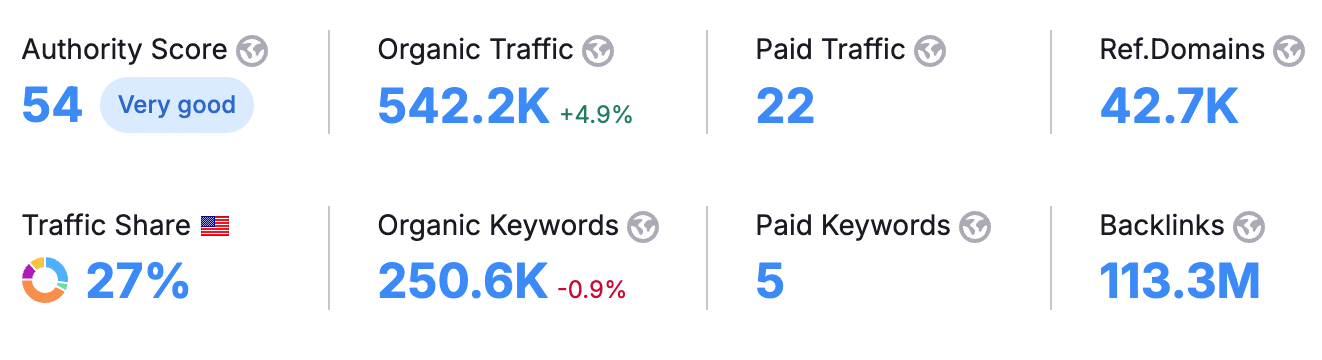
What’s functional with opportunity
Entity & Knowledge Graph
UWM has a strong external record: Wikidata, Wikipedia in 20 languages, and multiple canonical identifiers. A template edit would make the connection explicit on the site itself.Hierarchical Navigation
No major issues flagged. Anchor text refinements are worth making when the content work is underway.404 Errors
No issues flagged in this run. Test: https://uwm.edu/this-page-does-not-exist-12345.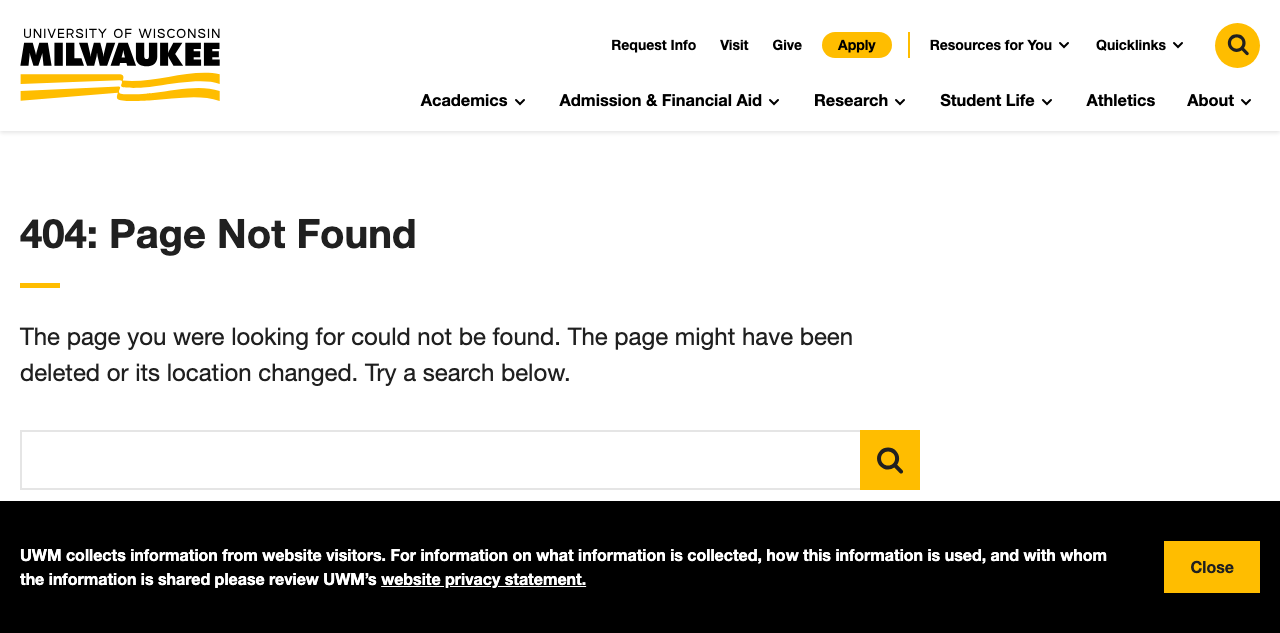
Audit Findings with Opportunity
The following sections organize the 18 opportunity items identified in the audit.
Executive summary: the opportunity is structural

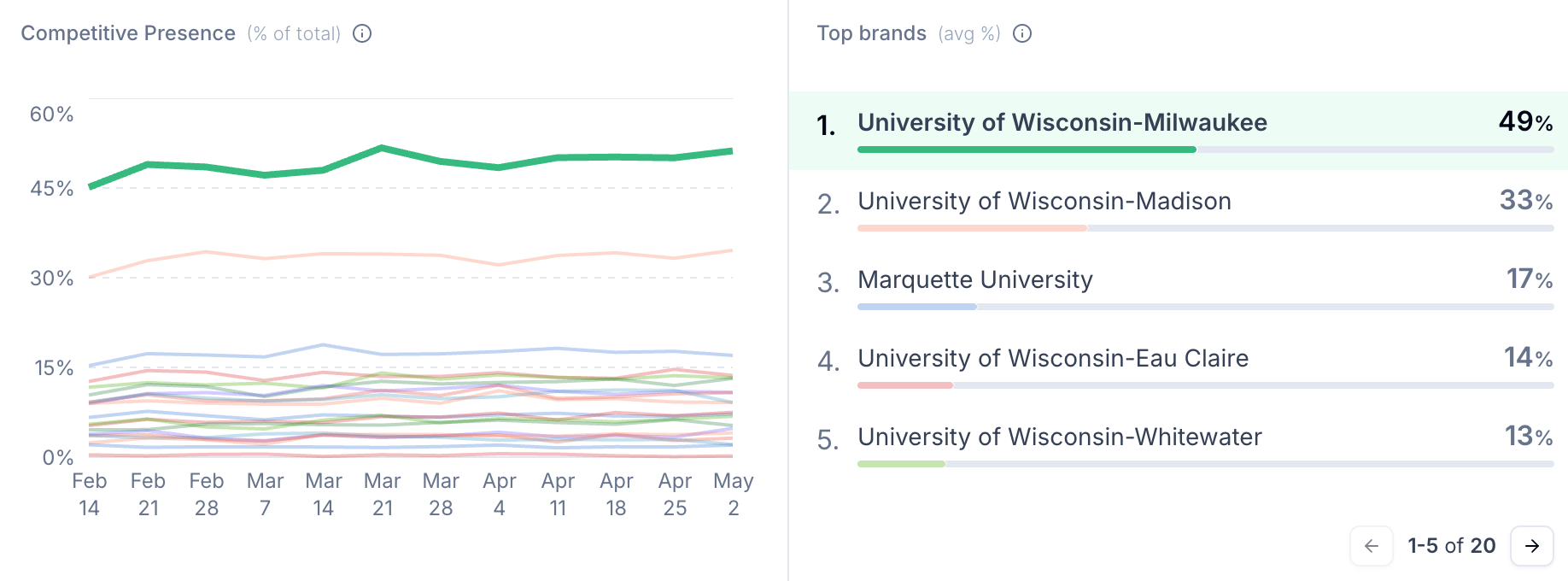
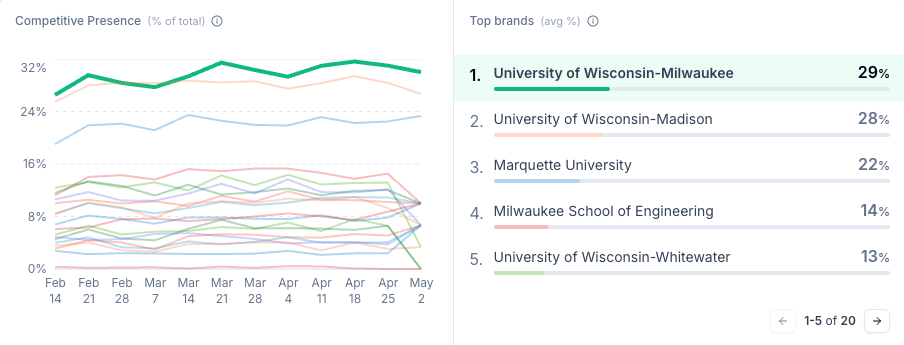
100% branded recall vs. 29% non-branded recall
UWM appears in 100% of AI responses when the prompt names UWM directly. When prompts ask for category recommendations without naming UWM, UWM appears in only 29% of responses.Highest-impact work
Structural and site-wide: program page authority, non-branded program category content, and schema markup.Second tier
Keyword opportunity at scale. MS in Management: Marketing ranks #13 for a phrase with 27,100 searches a month; treat it as the template for the full program inventory.Third tier
Operational hygiene: broken pages, redirects on the application path, broken links, and missing PDFs that affect discovery, crawl efficiency, and user experience.
Current AI & Organic Visibility
Branded organic strength
UWM ranks #1 for “uwm graduate school,” “uwm orientation,” “uw milwaukee graduate programs,” and others.Non-branded opportunity
The Master of Marketing Management page ranks #13 for a term with 27,100 monthly searches: one visible example across the portfolio.AI visibility pattern
100% presence across branded prompts; strong Milwaukee-specific non-branded queries; broader Wisconsin and national prompts fall off.Sentiment watchouts
Two low-sentiment prompts: UWM tuition vs other UW campuses (54) and UWM vs UW-Madison for undergrad (57).Transfer and internship prompts
“Best university to transfer to from a Wisconsin technical college”: 84%; “best internship opportunities”: 80%.Key takeaway
The 100% branded vs. 29% non-branded recall gap is the central finding: UWM needs to reach students who do not know UWM by name yet.
UWM leads regionally, but the awareness gap is exposed
Build category content
Create non-branded pages that answer top-of-funnel questions and position UWM as the answer.Close the awareness gap
Track and improve recall for prompts that do not name UWM directly.Deepen Engineering pages
Add program depth so UWM can compete on engineering-school prompts.Expand Scrunch competitors
Add SNHU and Phoenix to compare UWM against national online competitors.
On-Page Content & Page Structure
This is the most actionable section because every program page uses the same template.
Program pages need to surface the credentials UWM already has
Pages reviewed: /undergrad-admission/, /undergrad-admission/apply/, /undergrad-admission/apply/transfer/, /graduateschool/, /graduateschool/students/admission/, /academics/.
Five structural gaps
- No outcomes data
- No accreditation or licensure outcome content on program pages
- No “Maintained by” attribution
- Missing schema types across all page types
- Hub pages link to category pages, not named programs
Recommendations
- Improve the program-page template with semantic intros, key takeaways, accreditation, outcomes, named faculty, FAQ sections, and descriptive H2s.
- Restructure hub pages so /academics/, /graduateschool/, and college hubs link directly to named programs.
- Create awareness-stage category content and cross-link it from program and hub pages.
- Add trust signals: “Maintained by [Office],” contact paths, and “Last reviewed [date].”
News content needs AI-search structure and canonical plan to improve citations
AI retrieval structure
Add clear intros, key takeaways, descriptive H2s, and FAQ sections so AI systems can extract answers.Search-driven content layer
Build evergreen content around questions prospective students ask, clustered by program area so authority compounds over time.Duplicate content signal
Replace copied full-text stories on school/college subsites with teasers and links back to one canonical story; add canonical tags where needed.Content retention alignment
Time-bound news follows the two-year policy; evergreen career/program content stays live; milestone news folds into permanent About or History pages.
Keyword opportunity repeats across the program portfolio
The MS in Management: Marketing page ranks #13 for a term with 27,100 monthly searches.
It is the pilot and visible proof of an opportunity that repeats across the program portfolio.Recommendation
Use that page as the template. Align each program page’s title, meta description, H1, and internal links with its primary non-branded search phrase, then roll the optimization across the full program inventory.
E-E-A-T proof is lacking in content, despite clear authority and credibility
7 key findings (from 14 pages reviewed)
- Program accreditation is invisible
- Licensure outcomes are not published on program pages
- Faculty bio pages lack credentials and external profiles
- Author attribution is generic on substantive content
- Schema markup is the carrier for these signals
- Outcome data is not consistently published
- Departmental ownership and last-reviewed dates are implicit
Recommendation
- Review high-traffic pages for author bios, credentials, sources cited, publication dates, and contact information.
- Review first: /graduateschool/, /undergrad-admission/admitted-students/, /graduateschool/students/admission/.
UWM has real credentials.
The issue is that the strongest proof often does not appear on the pages where students and AI tools look for it.
Metadata, Links & Technical Foundations
These findings remove friction and make UWM’s content easier to understand, crawl, and attribute.
Metadata and image signals need a cleanup
Title tags & meta descriptions
Status: Needs Attention | Impact: High Impact | Complexity: High Difficulty. 48 titles outside the 30-60 character guideline; 130 pages missing meta descriptions.Image optimization
Status: Needs Attention | Impact: Medium Impact | Complexity: Moderate Difficulty. 37 images missing alt text; 8 images with generic filenames.Image recommendation
Add descriptive alt text, rename generic filenames to keyword-rich slugs, and host key images on the primary domain so AI systems can attribute image content back to UWM.
Internal links should push authority to priority pages
Finding
Most pages have 3 to 7 inbound internal links; the top 10% have 46+ and concentrate link authority.Gap
Descriptive anchors dominate (94%), but they describe categories rather than specific programs. No contextual program-name links surfaced.Recommendations
Add direct named program links through hub-and-spoke clusters, contextual news links, anchor-text variation, and links to strategically important underlinked pages.
Broken internal links interrupt application user experience
Finding
- 8 broken internal links across 12,196 in-scope links checked; all 14 are 404s.
- PDF resources related to articulation agreements are concentrated on registrar transfer-guide pages and are not linked from specific relevant degree pages.
- Six broken /academicaffairs/ links point to retired URLs; two additional pages return 404s.
- Highest-traffic source pages with broken links are part of the application path.
Recommendations
- Add a “Resources” jump link to degree pages and link related articulation agreements or PDFs.
- Update /academicaffairs/ link targets after the subsite restructure.
- Add automated 404 monitoring to catch the next round before it accumulates.
Most user-facing technical issue in the audit.
Prospective applicants are hitting redirects and then 404s on documents they need to complete their decision.
Technical foundations: small fixes plus mobile performance
Robots.txt
High impact, low difficulty. Robots.txt is present and working, but missing the Sitemap: directive that points crawlers directly to the XML sitemap.HTML sitemap
Low impact, low difficulty. UWM does not currently have the table-of-contents style page that helps users and crawlers navigate important sections.Page speed
High impact, moderate difficulty. Average mobile score is 43 and desktop is 65; three of five tested pages fall in the red band where users are most likely to abandon.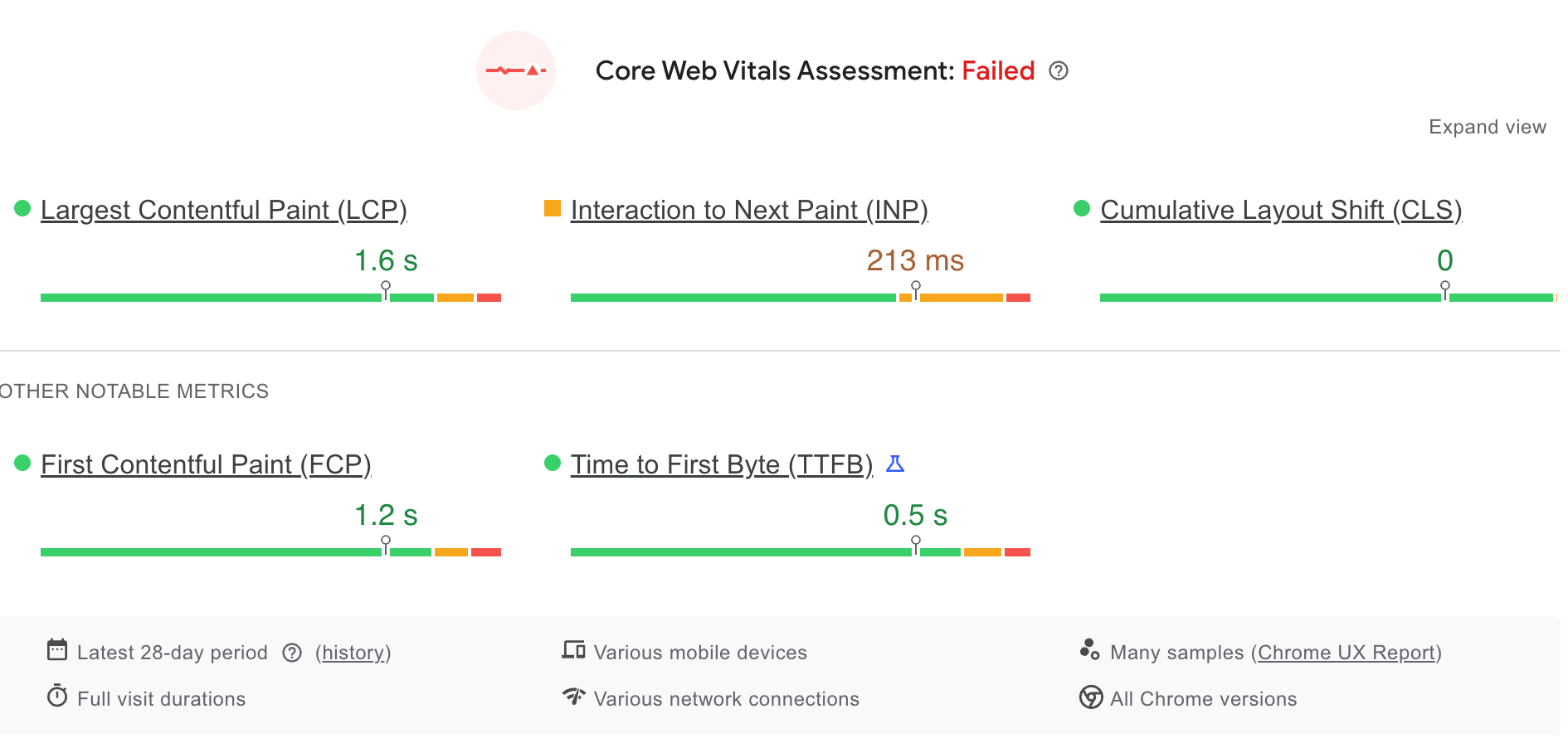
Technical foundations continued: CSS and redirects
CSS
Low impact, low difficulty. 6,696 render-blocking CSS or inline-style issues detected across the crawl. Recommendation: inline critical styles and defer non-critical stylesheets.Redirects
Medium impact, moderate difficulty. 27 pages return redirect status codes; 26 of 27 are trailing-slash redirects.Redirect recommendations
- Update the canonical XML sitemap to use trailing-slash URLs and re-submit in Google Search Console.
- Update application-path pages first, especially /undergrad-admission/apply/transfer/.
- Add a server-side trailing-slash rule so future paths normalize automatically and the double-slash artifact is removed.
Schema is the highest-leverage technical optimization to act on
Current state
Schema markup is present on all 14 sampled pages but limited to 6 generic types.Missing for higher ed
- EducationalOrganization
- Course + CourseInstance
- Person
- Event
- FAQPage
Key takeaway
Schema is how AI systems attribute your content, credentials, and programs to UWM specifically.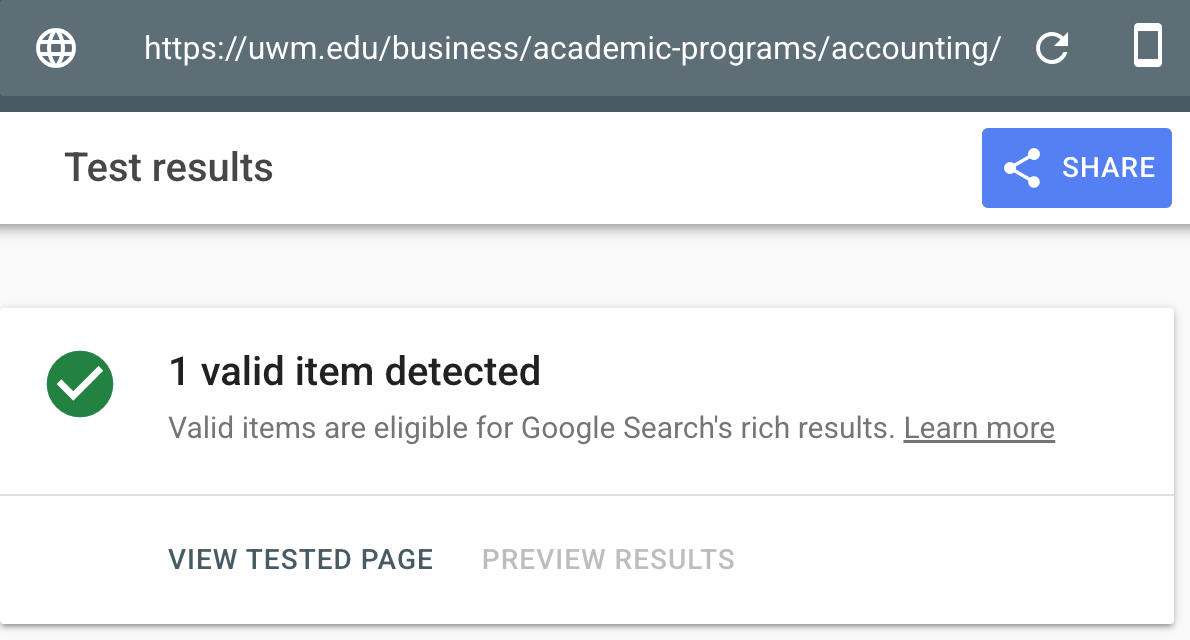
Canonicalization
Finding
- Two homepages are live: https://uwm.edu/ and https://uwm.edu/home/
- /home/ is the chosen canonical URL, sending the signal to search engines that /home/ is the preferred, live homepage.
Recommendation
Update the canonical version to the main domain (uwm.edu) and redirect the duplicative /home/ URL to uwm.edu.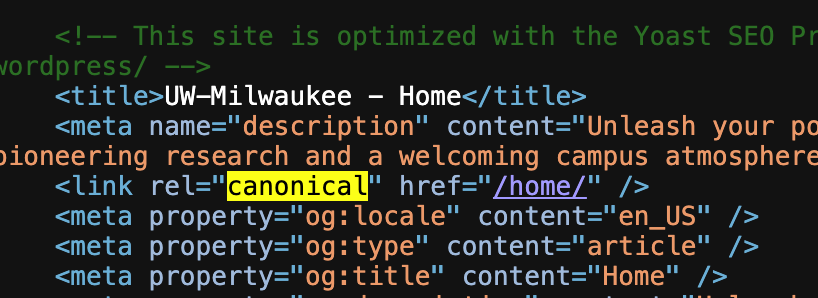
Off-Site Presence & Authority
The last section covers everything outside uwm.edu itself, including backlinks, how UWM is defined as an entity across the web, its social presence, and reputation signals.
Reputation & Reviews
Weakest sentiment themes
Tuition/value comparisons are the largest drag; commuter-school perception creates fit concerns; Milwaukee vs. Madison framing favors Madison on college experience.Specific risks surfaced
Tuition comparison prompts score 54.5 and 59.9; “Is UWM a commuter school?” scores 61.2; Milwaukee vs. Madison living scores 67.9; “Would I feel lost?” is borderline at 73.8.Key takeaway
These are content opportunities, not reputation crises: cost/value content and residential-life context can proactively frame the narrative.
PR and earned media can compound awareness-stage AI visibility
Good PR habits drive AI search support: faculty research, named graduate outcomes, accreditation milestones, and consistent links back to canonical UWM program pages.
National press foundation
New York Times, Fox News, ABC News, Harvard.edu, and peer .edu cross-references are already in the profile.Regional media link gap
Major regional outlets do not appear in UWM’s top-50 backlink referrers. Coverage may exist, but it is not registering as links.Key takeaway
UWM’s PR foundation is solid. The opportunity is targeted: build relationships with higher-ed trade publications, close the regional media link gap, and link stories back to canonical UWM program pages.
Q&A and Discussion
That’s the full picture for Audit 1. We’ve intentionally left time open for questions, clarification, and alignment.
The 3 levers that matter most
Program page authority
UWM has impressive credentials: R1 designation, Lubar College of Business accreditation, nursing licensure performance, and faculty experts, but those signals need to appear on program pages where prospective students and AI tools look for them.
Non-branded category content
Build pages that answer general questions without assuming someone already knows UWM, such as “best Wisconsin universities for [field],” “online degree programs in Milwaukee,” and “public R1 research universities in Wisconsin.”
Schema markup
Add EducationalOrganization, Course, Person, and FAQPage schema. Structured data labels page facts so AI systems can read and attribute them. It comes third because the content substance has to exist before schema can carry it.
Closing and next steps
Friday
Lubar College of Business Presentation
Deliver and present audit.
Friday
Chemistry & Biochemistry Presentation
Deliver and present audit.
Early June
Roadmap delivery
Translate findings into priority order, estimated effort, and recommended ownership.