
Tulane BMS Graduate Marketing
Preliminary Information
A preliminary recruitment-cycle framework for multiple Master of Science programs: timing, channel mix, landing pages, reporting, and investment ranges.

This information is meant to frame the conversation before a formal proposal.
The goal is to give program directors an initial view of cost, approach, and timeline for effective enrollment marketing campaigns.
A preliminary view of campaign structure, recommended timing, service mix, and budget ranges for graduate enrollment marketing.
A more formal proposal can be provided for specific interested programs and will consider economies of scale from managing multiple BMS programs concurrently.
Programs interested in a recommended approach and budget should complete a questionnaire so Search Influence can efficiently collect program-specific context.
A January media launch is possible. The work should start earlier.
Prospective students will be making decisions before summer deadlines. The strongest plan builds the foundation before campaigns go live.
Each MS program needs a page and message that clearly answers who it is for, why it matters, and what comes next.
Search and AI journeys should find Tulane when pre-health and biomedical science prospects compare options.
Program-level reporting should connect campaigns to inquiries, started applications, and lead quality.
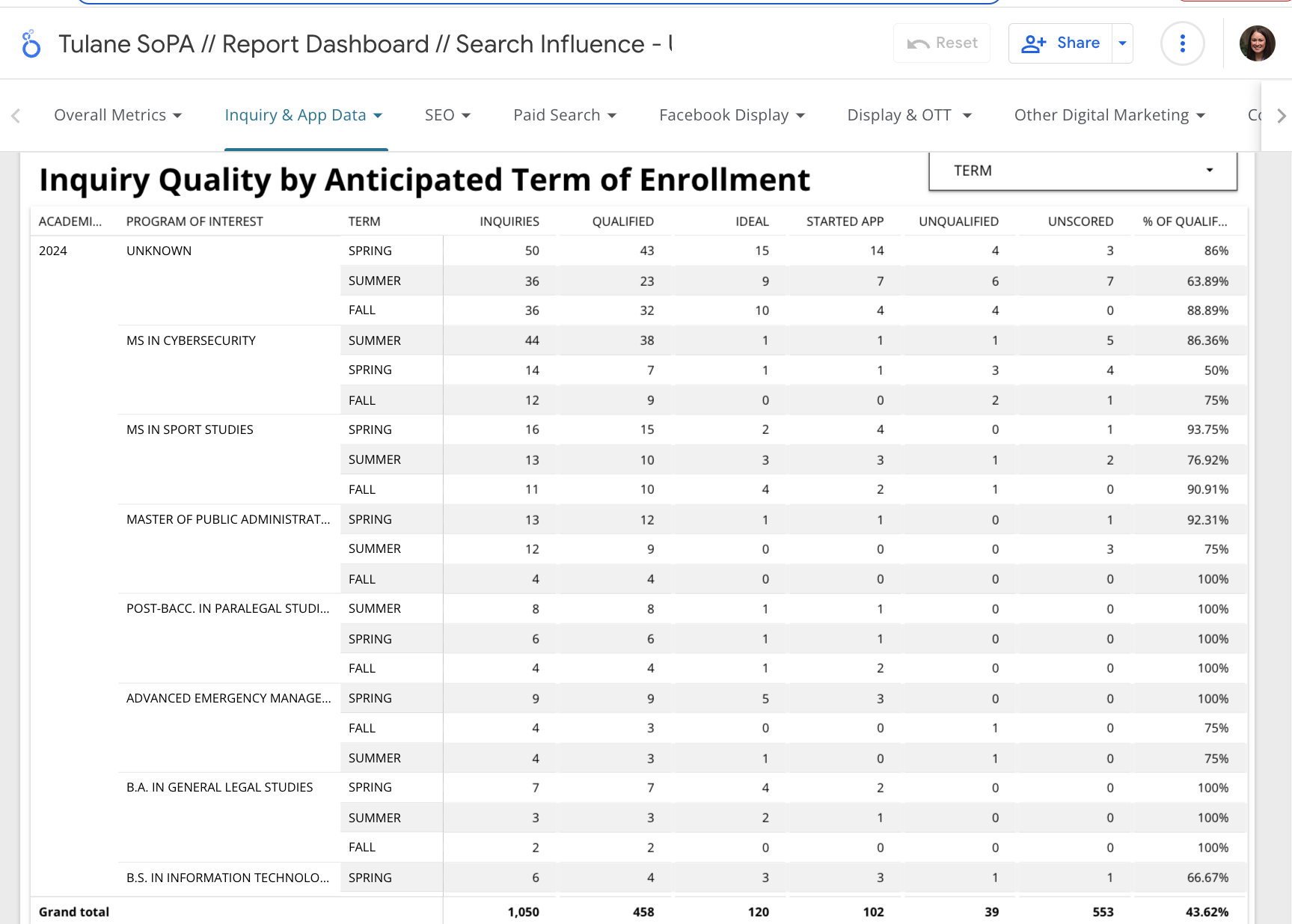
SoPA shows the value of an integrated, long-running enrollment funnel.
The SoPA model is not a one-time campaign precedent; it is a cross-channel system with program-level optimization and reporting discipline.
Non-traditional undergraduate program.
MPS Homeland Security Studies.
Master of Public Administration.
Across paid, optimization, dashboard, creative and support.
Source: Search Influence SoPA case study materials and FY26 planning inputs.
Deadlines cluster in summer. Recruitment should cover the full decision window.
Initial planning set based on the seven BMS one-year MS programs. Final participating program list and priority order should be confirmed before scope is finalized.
| Program | Public page | Published application timing |
|---|---|---|
| MS in Anatomy | Program page | July 31, 2026 |
| MS in Biochemistry & Molecular Biology | Program page | Rolling; generally full by mid-July |
| MS in Medical Genetics & Genomics | Program page | August 7, 2026 or until filled |
| MS in Microbiology & Immunology | Program page | August 15; international May 1 |
| MS in Molecular Medicine & Health Sciences | Program page | July 15 for Fall admission |
| MS in Pharmacology | Program page | August 1; first day/orientation August 17, 2026 |
| MS in Physiology | Program page | Fall only; BMS MS deadlines generally July 1–August 1 |
Public program pages reviewed May 14, 2026; final application-cycle dates should be confirmed with Tulane before launch planning.
Program research: deadline confidence and source caveats.
Use this to sanity-check what is client-ready versus what needs confirmation before a directors meeting.
| Program | Timing found | Confidence | Reviewer note |
|---|---|---|---|
| MS in Anatomy Program page | July 31, 2026 | High | Program eligibility page publishes a 2026 date; 1-year track runs Aug–May. |
| MS in Biochemistry & Molecular Biology Program page | Rolling; generally full by mid-July | Medium | Program page gives fall rolling timing, not a specific 2026 date. |
| MS in Medical Genetics & Genomics Program page | August 7, 2026 or until filled | High | Program page explicitly says Fall 2026 is open and gives August 7, 2026. |
| MS in Microbiology & Immunology Program page | August 15; international May 1 | Medium | Page gives dates but day-of-week appears older/stale; confirm 2026 in Slate/program office. |
| MS in Molecular Medicine & Health Sciences Program page | July 15 for Fall admission | Medium | Application page gives Fall deadline but not a 2026-stamped date. |
| MS in Pharmacology Program page | August 1; first day/orientation August 17, 2026 | High | Admissions page gives upcoming-year deadline and 2026 first-day date. |
| MS in Physiology Program page | Fall only; BMS MS deadlines generally July 1–August 1 | Low–Medium | Program application page does not publish a specific deadline; BMS FAQ gives the July 1–August 1 range. |
Plan in late summer. Build in fall. Launch in January. Optimize through deadlines.
This timing gives Tulane the best chance to launch with stronger pages, tracking, and message fit.
Use a shared foundation with segmented program campaigns.
A joint effort gives Tulane a shared planning and reporting foundation while letting each program tailor the audience, proof points, keywords, questions, and deadline messaging that will drive qualified leads.
- Audience research across pre-health and biomedical science segments
- General Tulane School of Medicine credibility
- Remarketing infrastructure and first-party audience review
- Common analytics, dashboard, and inquiry-quality framework
- Shared creative guardrails
- Program-specific search keywords and AI prompts
- Distinct outcomes, prerequisites, faculty/research angles
- One landing page per participating MS program
- Program-specific deadlines and calls to action
- Budget pacing based on demand and lead quality
Potential Approach Per Program
Each program can use the level of support that matches its urgency, audience size, enrollment goal, and channel fit.
Improve how well prospective students can find and understand each program via search engines and AI answers.
Create one conversion-focused landing page per participating program with clear inquiry/application paths.




Use 1–3 platforms based on demand, audience size, and budget.
Align inquiry follow-up and program messaging so prospects know the next step.
Track inquiries, applications, channel performance, program-level leads, and optimization priorities.
Paid media should be program-by-program, not equal-weight by default.
The price range Paula suggested is usable, but the deck should not imply every traditional biomedical science program deserves the same paid mix.
- Anatomy, Physiology, Pharmacology, Biochemistry, Medical Genetics likely have clearer pre-health/post-bacc search intent.
- Google Search + remarketing should be the first paid filter where query demand exists.
- Meta can support awareness/retargeting if budget is not too thin.
- Microbiology and Pathology may need narrower query sets and stronger landing-page proof before scaling paid.
- LinkedIn should be selective; niche pre-med audiences may be costly and hard to isolate.
- If budget is limited, prioritize AI SEO/landing pages/search before adding broad paid awareness.
Not every program needs the same paid media plan.
The strongest paid approach is selective: start with the channels most likely to reach each program’s prospective students and adjust based on lead quality.
Best first paid channel where search intent exists: “medical physiology MS,” “post-bacc biomedical science masters,” “pharmacology masters,” etc.
Useful for awareness, retargeting, lookalikes, and creative testing when audiences are large enough.
Use for professional/career-shift audiences or programs with job-title, field, or institution targeting logic. Higher cost means it should be chosen carefully.
Consider for awareness and short-form creative testing where program audience, message, and budget support it.
Reporting dashboard and insights will keep you informed of results and opportunities.
One shared dashboard with programs segmented appropriately.
Form submissions, source, campaign, landing page, and program interest.
Started applications, completed applications, and timing against deadlines where data is available.
Quality/qualification logic modeled on SoPA’s reporting discipline.
Track organic traffic, AI traffic, priority queries/prompts, and pages that need optimization.
Per program budgets scale by need and channel fit.
These ranges are intentionally preliminary. Final recommendations should follow each program’s urgency, audience size, search demand, and admissions path.
Per program for strategy, analytics setup, campaign setup, creative planning/production, landing-page build direction, and launch preparation.
AI SEO, landing page, 2–3 paid platforms, email/nurture recommendations, optimization, and dashboard/analytics reporting.
AI SEO plus one focused paid channel for programs with clear audience demand and a narrower paid-media test.
For programs where search/AI visibility and page optimization are the right first move before heavier media.
All ranges are per program. Setup is one-time; monthly options include dashboard/analytics reporting for preliminary planning. Recommended term: minimum 6 months; preferred 12 months for learning and optimization.
Open assumptions to confirm before client delivery.
These are the points most likely to change the recommendation, scope, or budget.
Use the questionnaire to turn this framework into program-specific recommendations.
After program directors review this preliminary information, each director can complete a short intake so Search Influence can recommend the right strategy, channel mix, and budget level for each program.
Questionnaire link: Tulane BMS Program Marketing Intake Questionnaire
Sources reviewed for the reviewer version.
Public source research was performed May 14, 2026. Keep client-facing deadline claims conservative until Tulane confirms the final program roster and application-cycle dates.
- Tulane BMS MS programs overview — medicine.tulane.edu/biomedical-sciences-graduate-program/master-science
- Tulane BMS Application Information — medicine.tulane.edu/biomedical-sciences-graduate-program/application-information
- Tulane BMS FAQ — medicine.tulane.edu/biomedical-sciences-graduate-program/application-information/faqs
- MS Anatomy eligibility/deadline — medicine.tulane.edu/structural-cellular-biology/masters/eligibility
- Biochemistry & Molecular Biology 1-year MS — medicine.tulane.edu/biochemistry-molecular-biology/masters-1-year
- Medical Genetics & Genomics MS — medicine.tulane.edu/centers-institutes/hayward-genetics-center/masters-medical-genetics-genomics
- Microbiology & Immunology MS — medicine.tulane.edu/microbiology-immunology/masters
- Pathology / Molecular Medicine MS — medicine.tulane.edu/pathology-laboratory-medicine/masters
- Pathology application page — medicine.tulane.edu/pathology-laboratory-medicine/masters/application
- Pharmacology MS admissions — medicine.tulane.edu/pharmacology/masters/admissions
- Physiology MS application information — medicine.tulane.edu/physiology/masters/application-information
- Bioethics & Medical Humanities MS — confirm if part of the participating set — medicine.tulane.edu/biomedical-sciences-graduate-program/ms-bioethics-medical-humanities