
Advanced 2026 · Boston
Agentic tools in action
Less busywork, more GEO
Automating the repetitive work that makes brands easier for AI systems to understand, cite, and trust.


Will Scott
- Trained as an architect, first website mid-90s
- Search Influence: 20+ years, New Orleans
- Coined "Barnacle SEO" in 2008
- First AI search talk: Feb 2023
See how deep the rabbit hole goes.
Do not get stuck on the label.
GEO, AEO, AI SEO, LLM SEO, E-I-E-I-O
GEO
Generative Engine Optimization. The formal label.
AEO
Answer Engine Optimization. The answer-focused label.
AI SEO
The phrase most clients understand quickly.
LLM SEO
The technical version. Useful, but not always client-friendly.
The outcome matters: being included in AI answers.
Strategy is not the bottleneck.
Repetition is.
Entity checks
Across pages, tools, engines, and competitors.
Content review
Across hundreds of URLs that were written for classic search.
Source coverage
Across channels the models may sample.
Verification
Because the answer can look finished before it is true.
Most cited sources are not shared across models.
Temso analyzed 2,045,102 citations from 134,673 AI responses across ChatGPT, Google AI Overview, Gemini, Grok, and Copilot.
71.1%
of cited domains appeared in only one model's responses
89%
of cited URLs were exclusive to one model
Source: Temso, March 2026
Ranking helps. It does not explain AI citations by itself.
37%
Google position 1 produced a citation in at least one of six AI systems for the same query in this benchmark.
Source: Murat Ulusoy / SUMAX Research, April 2026
Even inside Google, the source set changes.
Google Search
Classic ranked results
AI Overviews
Generated answer with citations
Gemini Flash 2.5
Assistant-style retrieval
Source: Grossman et al., arXiv, April 2026
You are not optimizing one page for one phrase.
You are managing evidence across source types.
1
Clarity
Make the entity unmistakable.
2
Connections
Make the evidence reinforce itself.
3
Ubiquity
Show up where the models look.
Workflow is the connective tissue that makes the work repeatable.
Clarity
The machine must understand you.
Entity profile
Category, services, geography, proof, relationships.
Human review
What is missing? What is wrong? What is under-supported?
Four questions every entity has to answer.
What are you?
Category, type, and definition.
What do you do?
Specific services, products, and capabilities.
Where and for whom?
Geography, audience, market, client type.
Who confirms it?
Reviews, associations, partners, citations, authors.
Proof of concept: URL in, entities out
theontologizer.com
SI-built, free. Useful for proving what can be extracted, not a full workflow by itself.
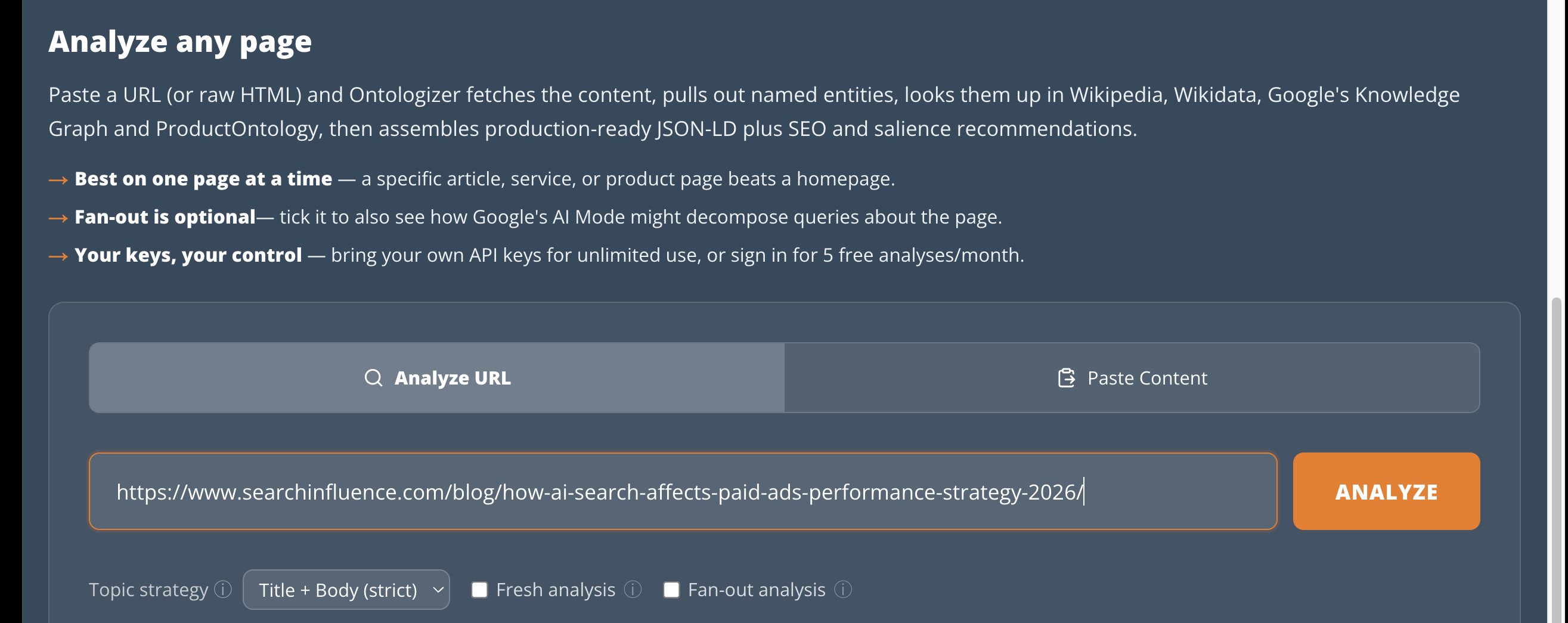
The tool finds candidates. You decide what belongs.
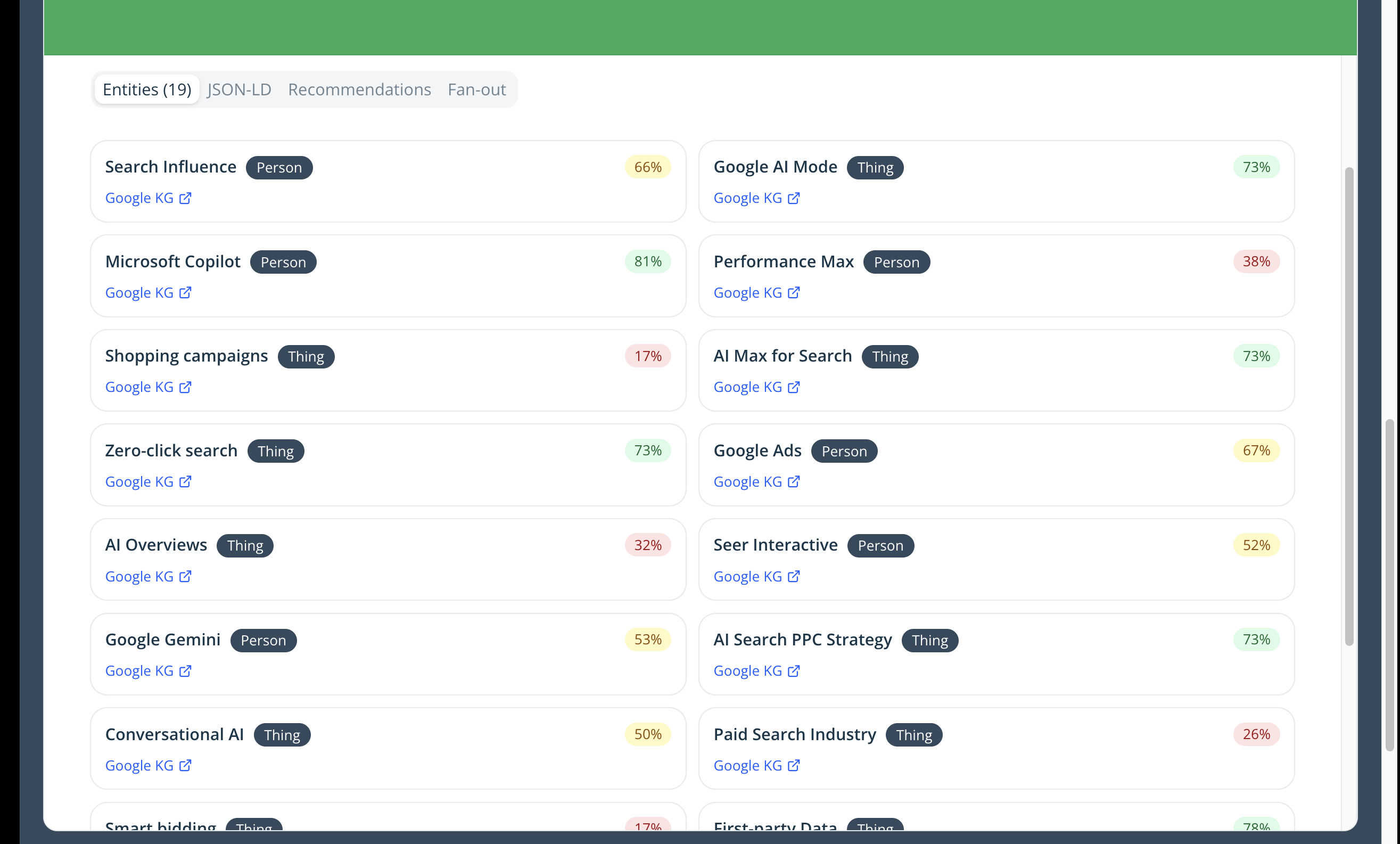
Review for strong entities, missing entities, and relationships the model overstates.
The prompt is only the starting point.
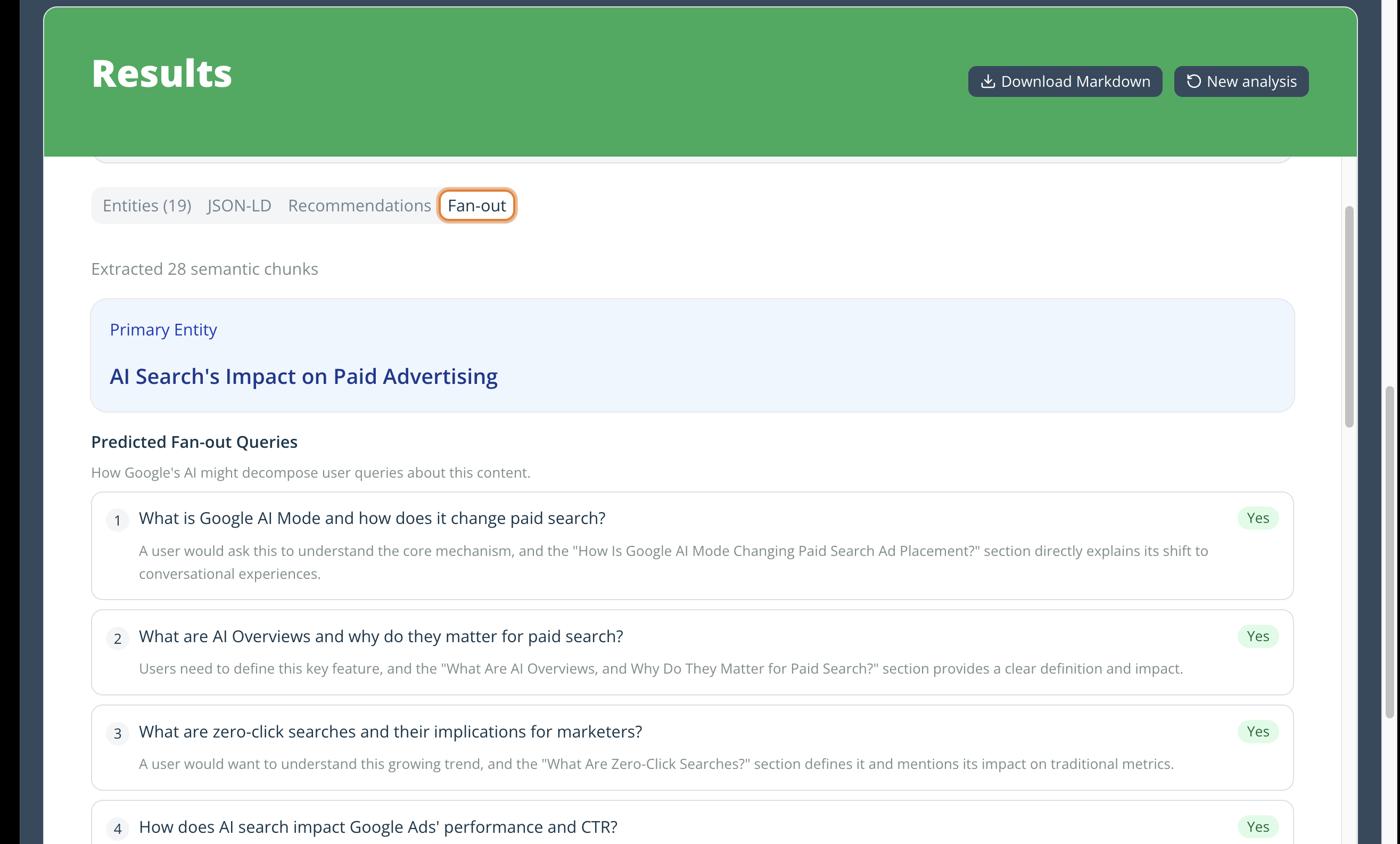
AI systems "fan out" for full query coverage.
A tool can produce an output. A workflow makes it useful every day.
Proof of concept
URL. Entities. Fan-out queries. Human review/next action.
Workflow
Task. Execution. Review. Distribution. Monitoring.
Build a GEO work loop.
This is the workflow. Your tools may vary.
Intake
Task comes in
Draft
System drafts
Review
Human makes the call
Advance
Move it forward
Learn
Tracking feeds back
Finding the issue is only half the work.
This is where GEO programs quietly stall: moving from finding to doing.
SI Studio turns task data into work product.
ClickUp provides the context. Studio packages the work for human review.
The workflow shows up where the team works.
ClickUp is the source of truth. Slack can be the review surface.
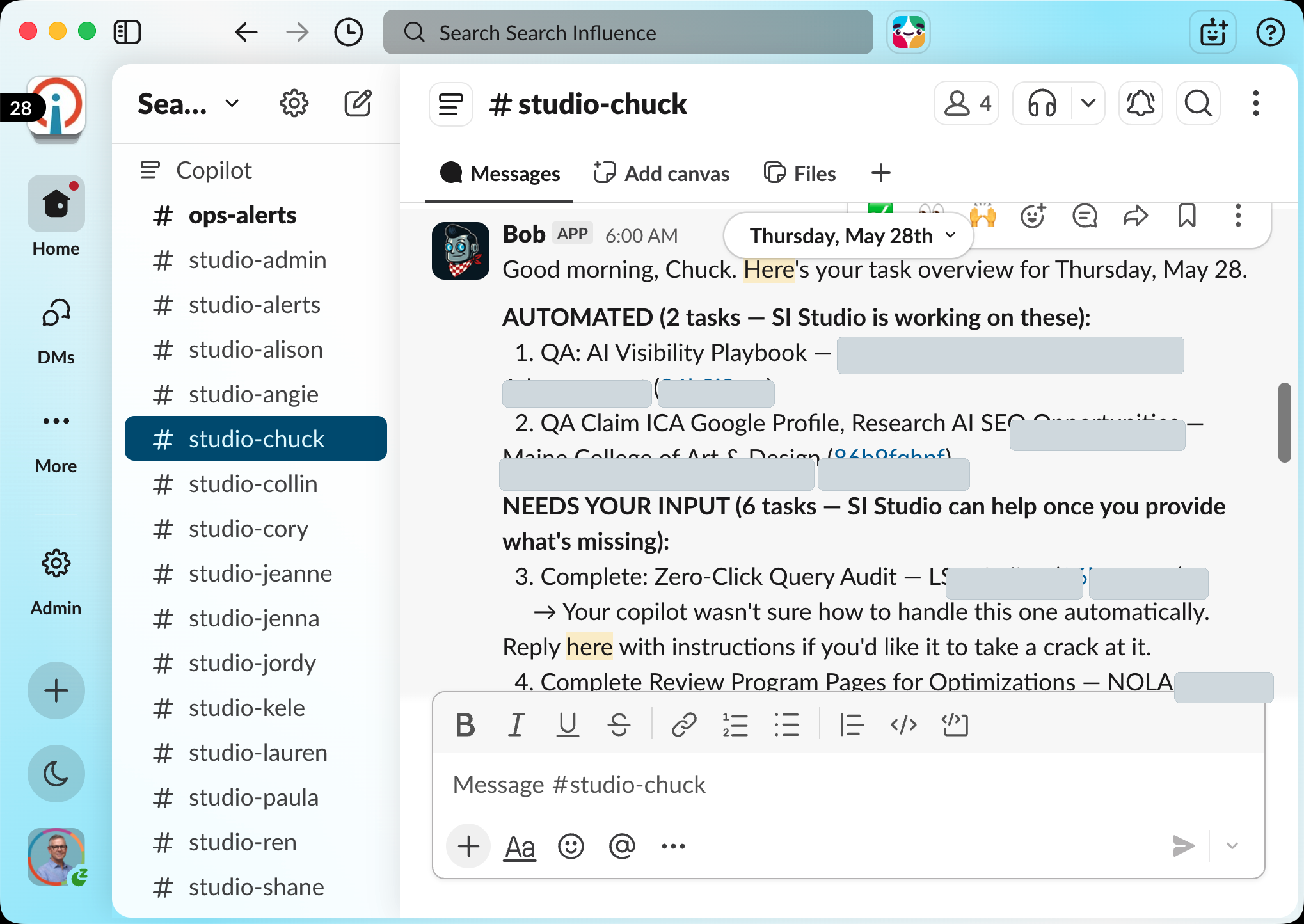
Customer names redacted. The human still reviews before anything ships.
Specificity gives the answer something to hold onto.
Before
"Best plumbing services in Chicago. Affordable rates and quality work."
After
"Licensed Chicago emergency plumbers serving Lincoln Park, Lakeview, and the Loop. 24/7 response within 45 minutes. EPA WaterSense certified. Member, Illinois Plumbing Association."
Automation without review is just faster risk.
Before anything ships, check three things.
Source
Is the claim supported?
Voice
Does it sound like us?
Action
Approve, revise, or stop.
Ubiquity = Probability
Coverage is not the same as control.
| Source type | Control | Influence | Monitor |
|---|---|---|---|
| Owned site | Yes | ||
| Local/listing data | Yes | ||
| Reviews | Yes | Yes | |
| Associations and partners | Yes | Yes | |
| Editorial / forums / social | Yes |
One strong page can create multiple source-ready assets.
Article
The proof lives here first.
URL
source material
Outputs
LinkedIn, carousel, short video, newsletter, internal link target, partner share.
URL to Social: URL in, distribution assets out.
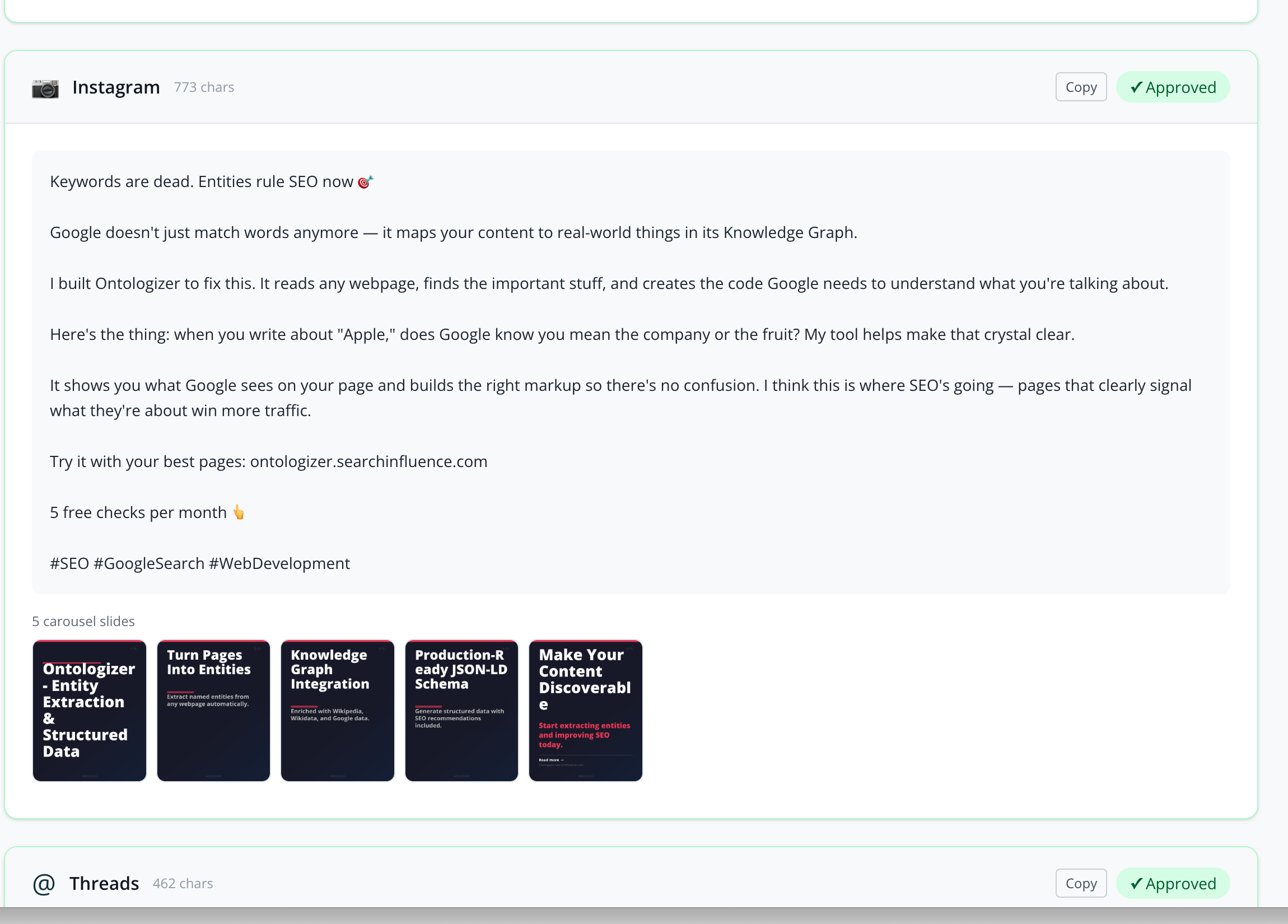
Internal SI example, not a public product. The repeatable pattern is URL -> channel assets -> review -> schedule.
Monitoring
Now track the shift.
Distribution without measurement becomes more busywork.
The same brand can move differently by engine.
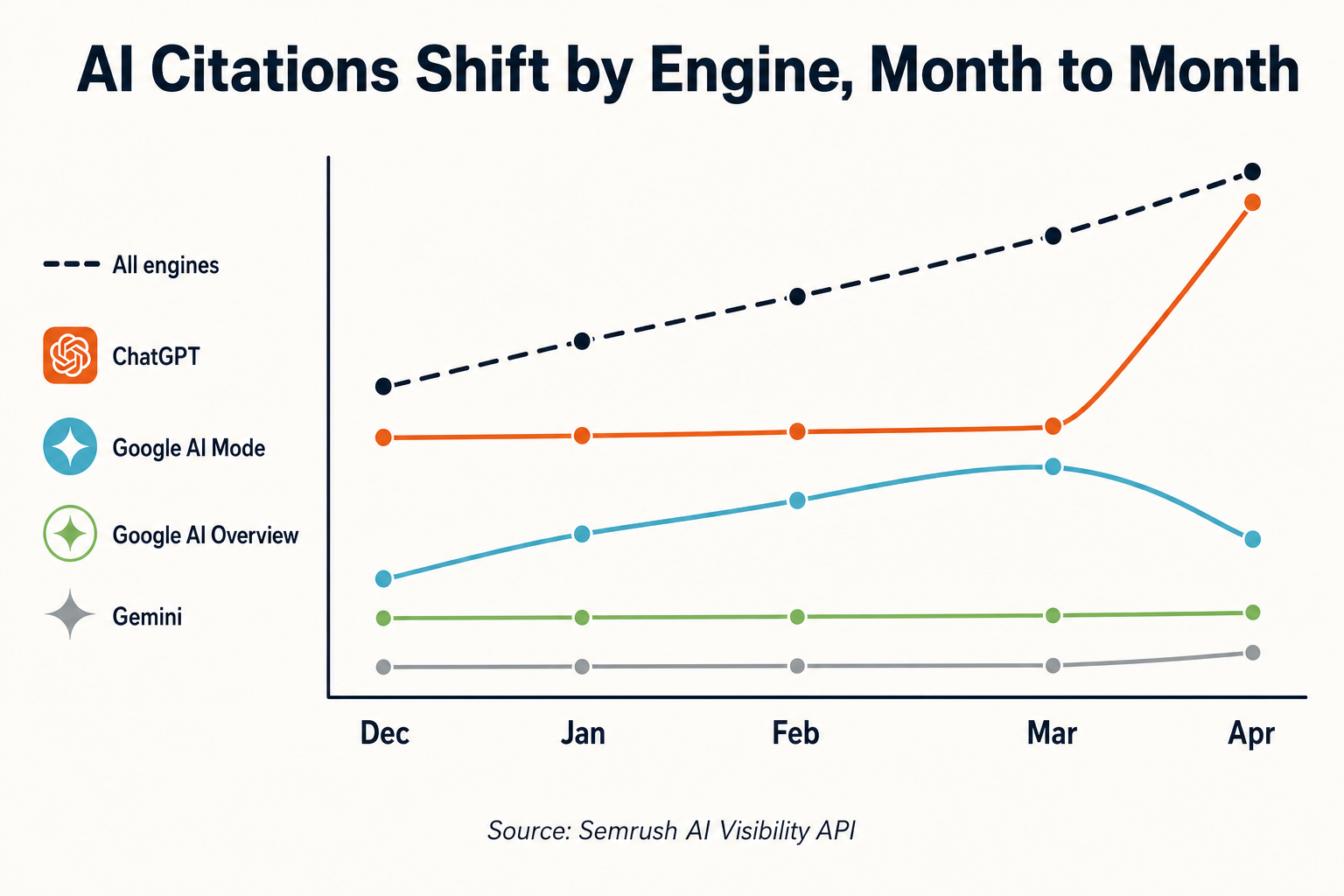
Source: Semrush AI Visibility API; limited availability.
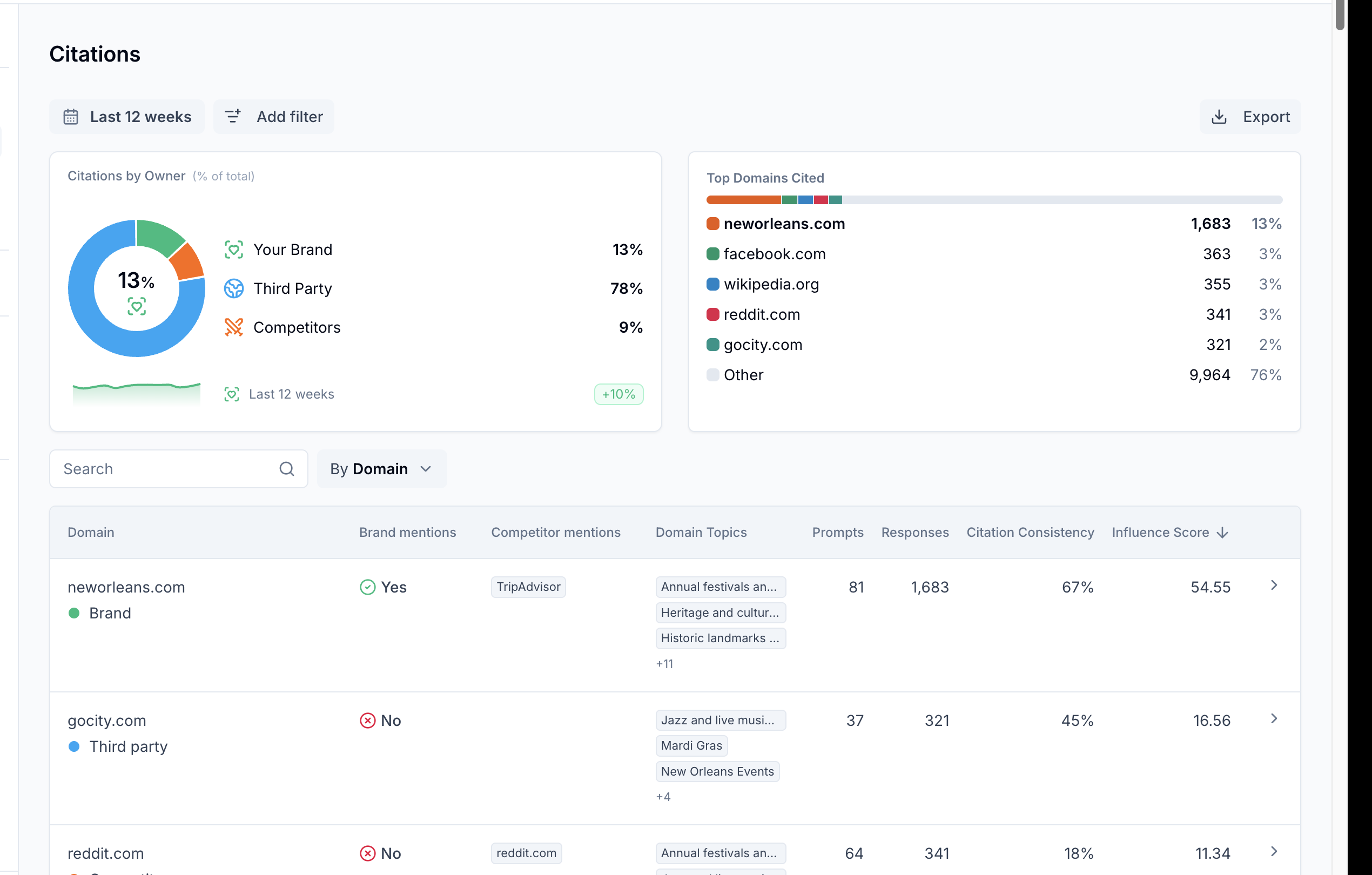
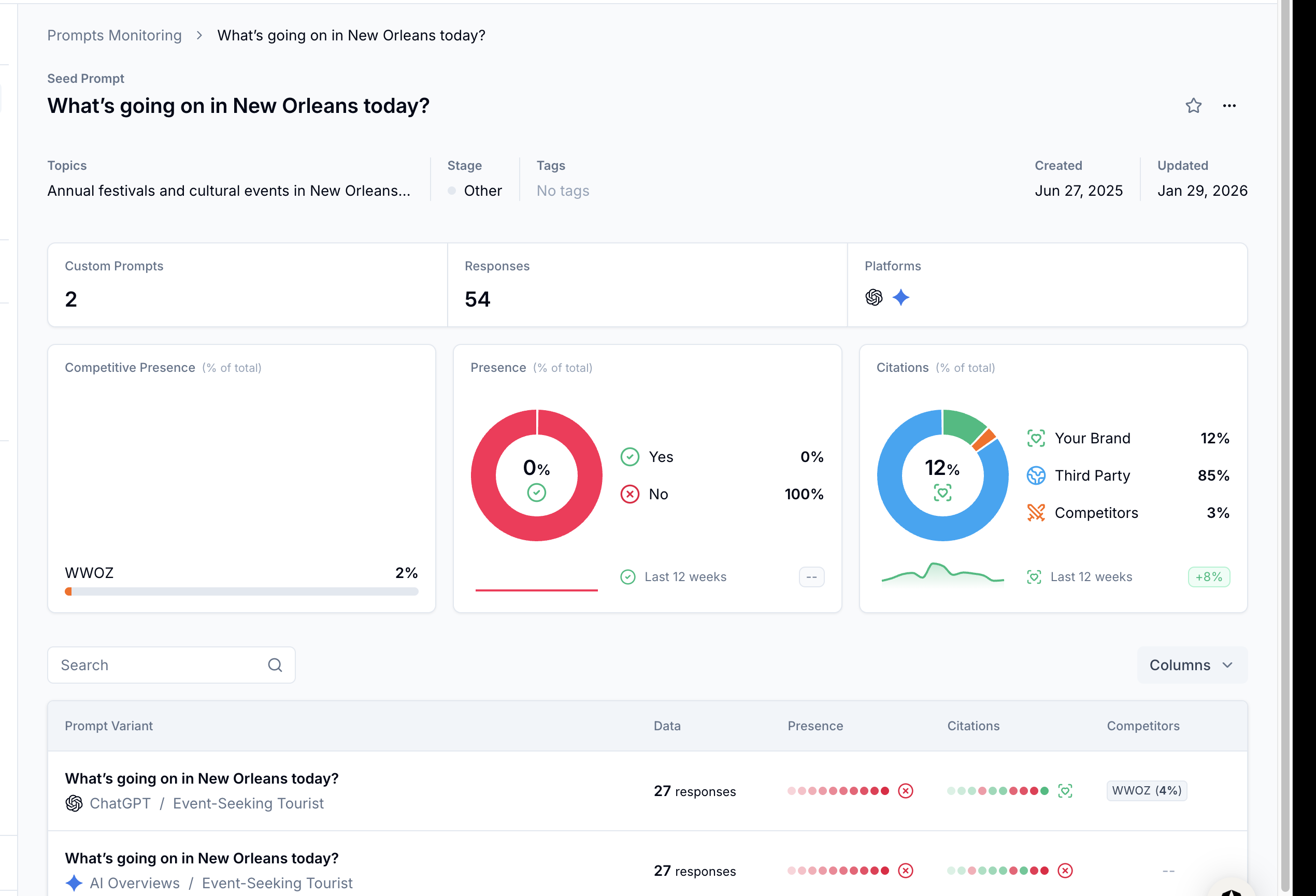
Dashboards should feed decisions, not become another chore.
The answer can look finished before it is true.
Hallucination
A confident fact with no source.
Voice drift
Technically correct. Wrong brand.
Stale source data
Good answer, old reality.
Build a GEO work loop.
Human judgment stays in the loop.
Intake
Task comes in
Draft
System drafts
Review
Human makes the call
Advance
Move it forward
Learn
Tracking feeds back
Three things to do now
Run one page through The Ontologizer.
Turn one GEO task into an AI workflow.
Turn one page into three distributable assets.
Thank you

willscott.me/links